 (604) 305-2992
 Schedule An Appointment
Facing a broken appliance and wondering if that repair quote makes financial sense, or if it’s finally time to bite the bullet on a replacement? You’re definitely not alone—this tricky decision becomes even more complex when you factor in Chiliwack’s unique climate challenges and the current appliance market conditions. Picture this: It’s a rainy Tuesday morning in Sardis, you’re rushing to get coffee before work, and your trusty dishwasher decides to start leaking all over your kitchen floor. The repair technician gives you that familiar look—the one that screams “this is going to hurt your wallet”—and suddenly you’re stuck making one of homeownership’s most frustrating financial decisions.  Do you invest more money into your faithful but aging appliance, or do you shell out for a shiny new replacement that’ll probably cost twice what you paid five years ago? Living here in the Fraser Valley, we’ve got some unique challenges that make this decision even trickier than it already is. Our beautiful location comes with humidity that can absolutely wreak havoc on appliances, seasonal temperature swings that stress mechanical components, and BC Hydro rates that make energy efficiency more important than ever for our monthly budgets.
Key Outtakes:
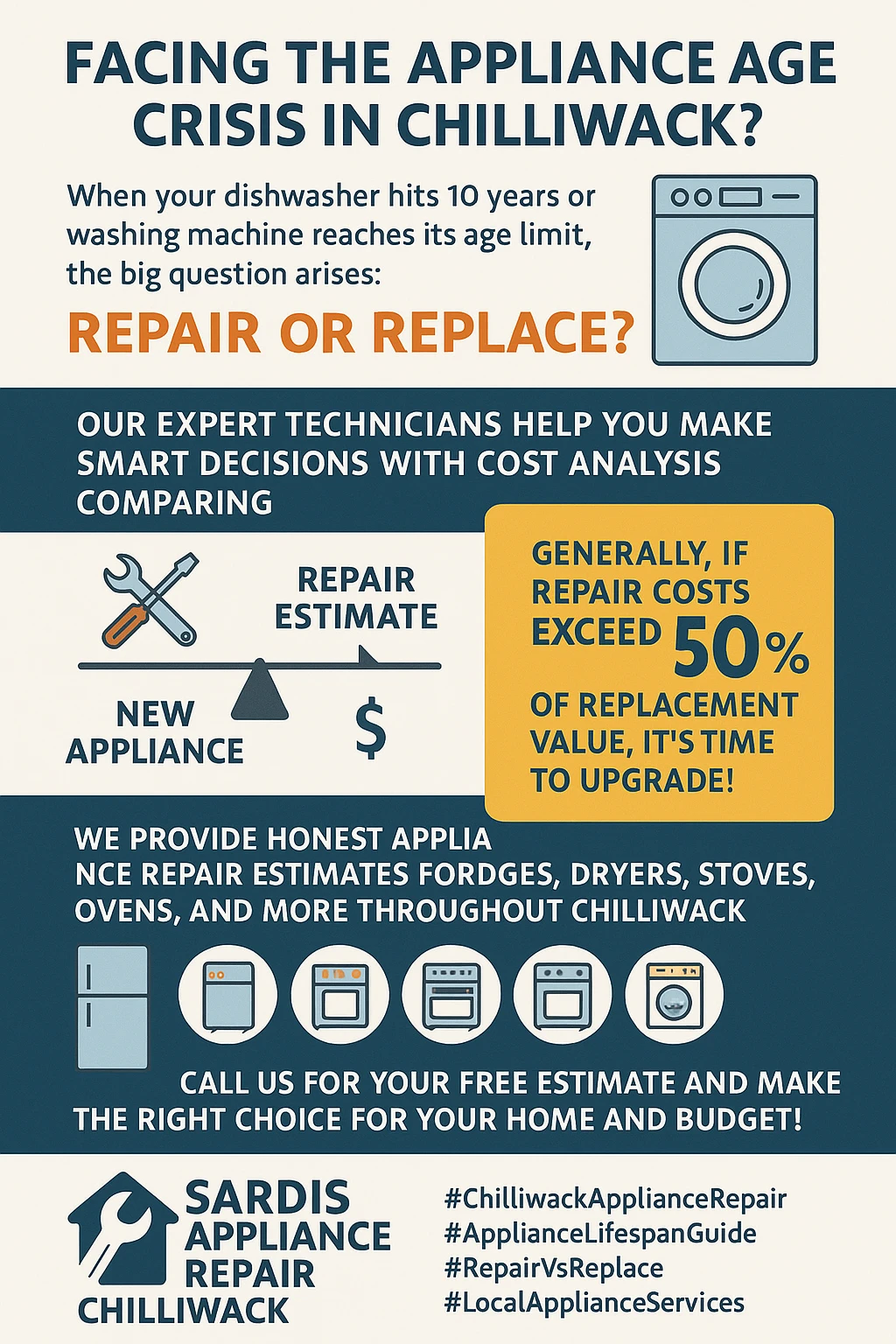
- Apply the 50% rule as your baseline: replace when repair costs exceed half the price of a comparable new appliance
- Appliances over 10-15 years old typically favor replacement due to declining efficiency and increasing failure rates
- Chiliwack’s Fraser Valley climate accelerates appliance wear through humidity and temperature fluctuations, making proactive maintenance crucial
- Energy efficiency improvements in newer models can offset replacement costs through reduced BC Hydro bills over time
- Seasonal timing and local service availability significantly impact repair versus replacement economics in our region
Understanding the Real Cost of Appliance Repairs in Chiliwack
Before you can make a smart repair versus replacement decision, you need to understand what you’re actually paying for when that service truck pulls up to your driveway in Vedder Crossing or Promontory. The Fraser Valley has developed its own pricing structure that reflects both competitive rates and the unique service challenges of our region. Most local appliance repair companies charge a flat diagnostic fee upfront, typically around $139, regardless of whether you decide to proceed with the repair or not. What catches many homeowners off guard is how repair costs break down beyond that initial diagnostic visit. Labor charges generally run between $50-100 per hour depending on the complexity of the work and the technician’s expertise level. Simple repairs like replacing a dishwasher filter or fixing a loose dryer belt might only require 30 minutes of work, while complex issues like replacing a refrigerator compressor could easily take several hours plus ordering time for specialized parts. Parts costs vary dramatically depending on your appliance’s age and brand. Common components like heating elements, pumps, or control boards for mainstream brands like Whirlpool or GE typically cost $50-200 in our market. However, if you own a high-end European brand or your appliance is over 10 years old, parts can easily cost $300-500 or more. This is where many repair decisions become crystal clear—when the part alone costs more than half of what you’d pay for a new appliance.
The 50% Rule and When It Actually Makes Sense
Moving from understanding costs to making the actual decision, the appliance repair industry has long relied on what’s known as the 50% rule as a quick decision-making tool. This guideline suggests that if your repair cost exceeds 50% of what you’d pay for a comparable new appliance, replacement typically offers better long-term value.  However, this rule requires some serious nuance when applied to Chiliwack’s specific market conditions and the realities of modern appliance shopping. When calculating that 50% threshold, you need to make sure you’re comparing apples to apples. If your 12-year-old dishwasher needs a $350 repair, don’t compare that to the cheapest new model you can find online. Instead, look at what it would actually cost to replace your unit with something of similar size, features, and build quality. A basic new dishwasher might cost $600, but if yours has features like a third rack, stainless steel interior, or quiet operation, the comparable replacement could easily run $1,200-1,500. Age plays a critical role in this calculation that goes way beyond simple math. Appliances under five years old almost always favor repair, assuming the issue isn’t a fundamental design flaw that’s likely to recur. These units typically still have reasonable parts availability, may have remaining warranty coverage, and haven’t yet experienced the cumulative wear that leads to multiple system failures down the road. For appliances in that tricky 5-10 year range, the decision becomes much more complex and depends heavily on the specific issue and your appliance’s maintenance history. A well-maintained refrigerator that’s had regular coil cleaning and proper care might absolutely be worth a $400 compressor replacement at eight years old. The same exact repair on a neglected unit that’s already had multiple fixes probably isn’t a wise investment of your hard-earned money.
Climate Impact on Appliance Lifespan in the Fraser Valley
Understanding realistic appliance lifespans becomes crucial when you’re trying to figure out how much useful life you’re actually purchasing with your repair investment. However, most published lifespan data reflects ideal conditions that simply don’t account for our Fraser Valley climate and the unique usage patterns that come with living here. Real-world lifespans in areas like Chilliwack and Rosedale tend to run 10-20% shorter than national averages due to humidity-related stress and those temperature fluctuations we experience throughout the year.  Refrigerators typically last 10-15 years under normal conditions, making them worthwhile repair candidates until around year 12 in most cases. These workhorses depreciate slowly because they run continuously, meaning a major repair at year 8 could still provide 4-6 years of additional reliable service. However, refrigerator compressor failures after year 10 usually signal replacement time since other critical systems will likely start failing in sequence. Washing machines and dryers fall into the 10-12 year lifespan category, but their repair worthiness varies dramatically by the type of issue you’re facing. Drive motor replacements at year 7-8 often make perfect sense financially, while control board failures in the same timeframe frequently don’t due to the high cost of electronic components. Front-loading washers face additional challenges from seal and bearing failures that can cost $400-600 to repair properly—sometimes more than the machine is actually worth. Dishwashers have the shortest typical lifespan at 8-10 years, largely due to their constant exposure to food debris, grease, and harsh detergents. However, they’re also among the most repair-friendly appliances for simple issues. A $150 pump replacement on a 6-year-old dishwasher usually makes sense, while the same repair on a 12-year-old unit probably doesn’t, especially considering how much more efficient newer models have become.
Energy Efficiency and Long-Term Savings
Transitioning from lifespan considerations to the bigger financial picture, energy efficiency improvements in newer appliances can actually offset replacement costs through reduced utility bills over time—something that’s particularly important given BC Hydro’s rate structure. This factor often tips the scales toward replacement even when repairs might seem financially viable on the surface. Modern ENERGY STAR refrigerators use approximately 15% less energy than models from just 5-7 years ago, and the difference becomes even more dramatic when comparing to units over 10 years old. For a typical household, this can translate to $50-100 in annual savings on electricity costs. Over the 12-15 year lifespan of a new refrigerator, those savings can add up to $600-1,500—essentially paying for a significant portion of the replacement cost. Washing machines have seen some of the most dramatic efficiency improvements in recent years. New high-efficiency models use up to 25% less energy and 35% less water compared to standard models from a decade ago. Given the cost of both electricity and water in our region, these savings can be substantial for families who do multiple loads per week. The efficiency gains become even more pronounced when you factor in reduced wear on your hot water heater and septic system. The environmental impact deserves consideration too, especially for environmentally conscious homeowners throughout the Fraser Valley. Keeping an inefficient appliance running for a few more years might seem like the “green” choice, but the increased energy consumption often outweighs the environmental cost of manufacturing a new, efficient unit. Modern manufacturing processes have also become more environmentally friendly, and many old appliances end up being recycled into new products anyway.
Frequently Asked Questions
How do I know if my appliance repair is worth the cost?
Use the 50% rule as your starting point: if the repair costs more than half of what you’d pay for a comparable new appliance, replacement usually makes more financial sense. However, also consider the age of your appliance, its maintenance history, and whether this is likely to be the first of multiple expensive repairs. For appliances under 5 years old, repairs almost always make sense unless you’re dealing with a fundamental design flaw.
What’s the average lifespan of major appliances in our climate?
In the Fraser Valley’s humid climate, expect slightly shorter lifespans than national averages. Refrigerators typically last 10-13 years, washing machines and dryers 8-12 years, dishwashers 7-9 years, and ranges 12-15 years. Regular maintenance can extend these lifespans significantly, while neglect can shorten them by several years. The key is keeping up with routine cleaning and addressing small issues before they become major problems.
Should I factor in energy savings when deciding to replace an older appliance?
Absolutely, especially with BC Hydro rates. Modern appliances can use 15-30% less energy than models from even 5-7 years ago. For high-use appliances like refrigerators and washing machines, this can translate to $50-150 in annual savings. Over the life of a new appliance, these savings can offset a significant portion of the replacement cost, making replacement financially attractive even when repairs might technically be possible.
Wrapping Up
Making the repair versus replacement decision doesn’t have to feel like financial roulette when you understand the key factors at play. By considering your appliance’s age, the true cost of repairs including hidden replacement expenses, the impact of our Fraser Valley climate, and the long-term savings potential of modern efficient models, you can make informed decisions that protect both your budget and your peace of mind. When that next appliance emergency strikes—and it will—you’ll be prepared to make the right call for your specific situation and household needs. Whether you decide to repair or replace, Sardis Appliance Repair Chiliwack is here to help guide you through the process with honest assessments and transparent pricing. Our experienced technicians understand the unique challenges of maintaining appliances in our climate and can provide the expert advice you need to make the best financial decision for your family.